Middlesex County, Massachusetts
Defending JacobMiddlesex County, Massachusetts, is the setting for Jacob Barber’s prosecution and trial, where the criminal case unfolds within a courthouse system that is both procedural institution and public stage. The county’s legal culture shapes who handles the case, how the trial is presented, and how competing explanations are made to seem persuasive.
Courthouse Culture and Judicial Assignment
Trials in Middlesex County were ostensibly assigned to judges at random, but the account describes a recurring pattern in which the same judges received prominent cases. The process was treated as an entrenched courthouse routine, difficult to challenge; the judges who repeatedly drew high-profile trials were often ambitious personalities who pursued the assignments behind the scenes. The narrator suggests that those judges’ egos could serve a practical purpose in contentious proceedings, while also turning major cases into a kind of show.
Jacob’s trial was assigned to Burton French, a judge familiar to local audiences through television appearances. In public, French projected certainty and a composed, authoritative image; lawyers who encountered him in the courthouse regarded that image as at odds with a reputation for seeking publicity, limited intellectual depth, and petty courtroom control. The contrast between his televised gravitas and the lawyers’ private assessment makes the county’s justice system appear partly shaped by performance and reputation as well as law.
The narrator nevertheless saw French as an advantage for the defense. French was conservative and unlikely to embrace a novel theory such as the Murder Gene, and he liked to test lawyers, particularly those who appeared uncertain or unprepared. The narrator believed that putting Neal Logiudice before a judge with this temperament could expose the prosecutor’s weaknesses. Because the narrator could no longer participate in the case, the choice of prosecutor and judge carried added strategic weight.
The County’s Legal Institutions
The Middlesex District Attorney’s Office had a specialized investigative unit, CPAC, or Crime Prevention and Control. Paul Duffy testified that it comprised roughly fifteen to twenty detectives with training and experience supporting prosecutors and local departments in complex investigations, particularly homicide cases. The unit’s role illustrates the county’s integration of investigative personnel with prosecution, while Duffy’s prepared, rote recitation of its remit also shows how institutional identity enters the trial through witness testimony.
The investigation encountered local concerns about interviewing students at the school. Duffy testified that there had been a delay in gaining access, amid parents’ concerns about questioning children and discussion of whether students needed lawyers present. Officials also debated whether investigators could enter the school and lockers without a warrant, whether the school building was an appropriate interview site, and which students could be interviewed. These disputes show the practical limits and contested boundaries of an investigation conducted within the county, rather than a frictionless passage from suspicion to evidence.
Trial as Public Narrative
The trial began in the county courthouse before an unusually large jury pool and a crowded gallery. Proceedings started late as staff arranged a shared pool-camera feed for news outlets, including Court TV, and organized the prospective jurors. The delay made the trial’s public dimension tangible: the case was not only being presented to a jury in the courtroom but also prepared for a television audience beyond it.
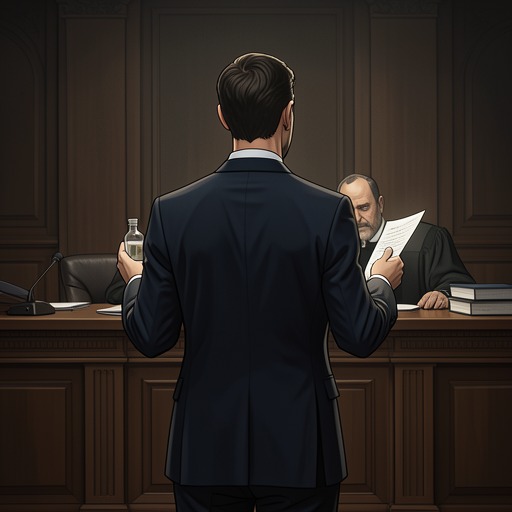
When French took the bench, the clerk called the case as a single count of first-degree murder against Jacob, with Jonathan Klein representing the defense and Neal Logiudice appearing for the Commonwealth. The judge’s attention briefly conferred significance on each person he looked at, a small courtroom gesture that captures the trial’s transformation of defendant, lawyers, and family into public figures under institutional scrutiny.
Logiudice’s opening argument supplied the prosecution’s organizing story. He emphasized that Ben Rifkin, a fourteen-year-old, had been killed in Cold Spring Park on a spring morning, and presented Jacob as a boy with advantages whose temper had suddenly erupted after ordinary teasing. He acknowledged that Ben was not a saint and that the jury would hear that he had teased Jacob, while insisting that such behavior was commonplace and did not justify the killing. The account of the case thus depended not only on evidence but on a causal narrative that made the violence intelligible to jurors.
The narrator observes that a lawyer must give jurors a story, a theme they can carry into deliberations; Logiudice reduced his theory to the claim that Jacob had snapped. Yet the prosecutor could not identify a definite trigger. He offered possibilities about insults or bullying and conceded that the reason might never be known. The gap between his confident theme and his speculative account of motive exposes a central tension in the county trial: persuasive courtroom narrative can organize uncertainty, but it cannot itself resolve it.